DeskSignal may earn a commission from merchant links on this page at no extra cost to you when you purchase desktop audio gear. How DeskSignal earns affiliate referral commissions
The SMSL A300 occupies a specific niche in modern desktop audio. While listed and marketed by retailers as a power amplifier, it is functionally a compact Class D integrated amplifier equipped with digital inputs, an onboard volume stage, and remote control. For listeners running passive bookshelf speakers on a desk or small listening station, it promises significant power on paper—specifically 85 watts per channel into 8 ohms and 165 watts into 4 ohms—at an accessible price point near $195.
Deciding whether the A300 belongs in your desktop chain requires looking past nominal wattage figures to evaluate how its input stage, tone controls, 2.1 subwoofer routing, and bridgeable architecture perform in everyday nearfield setups.
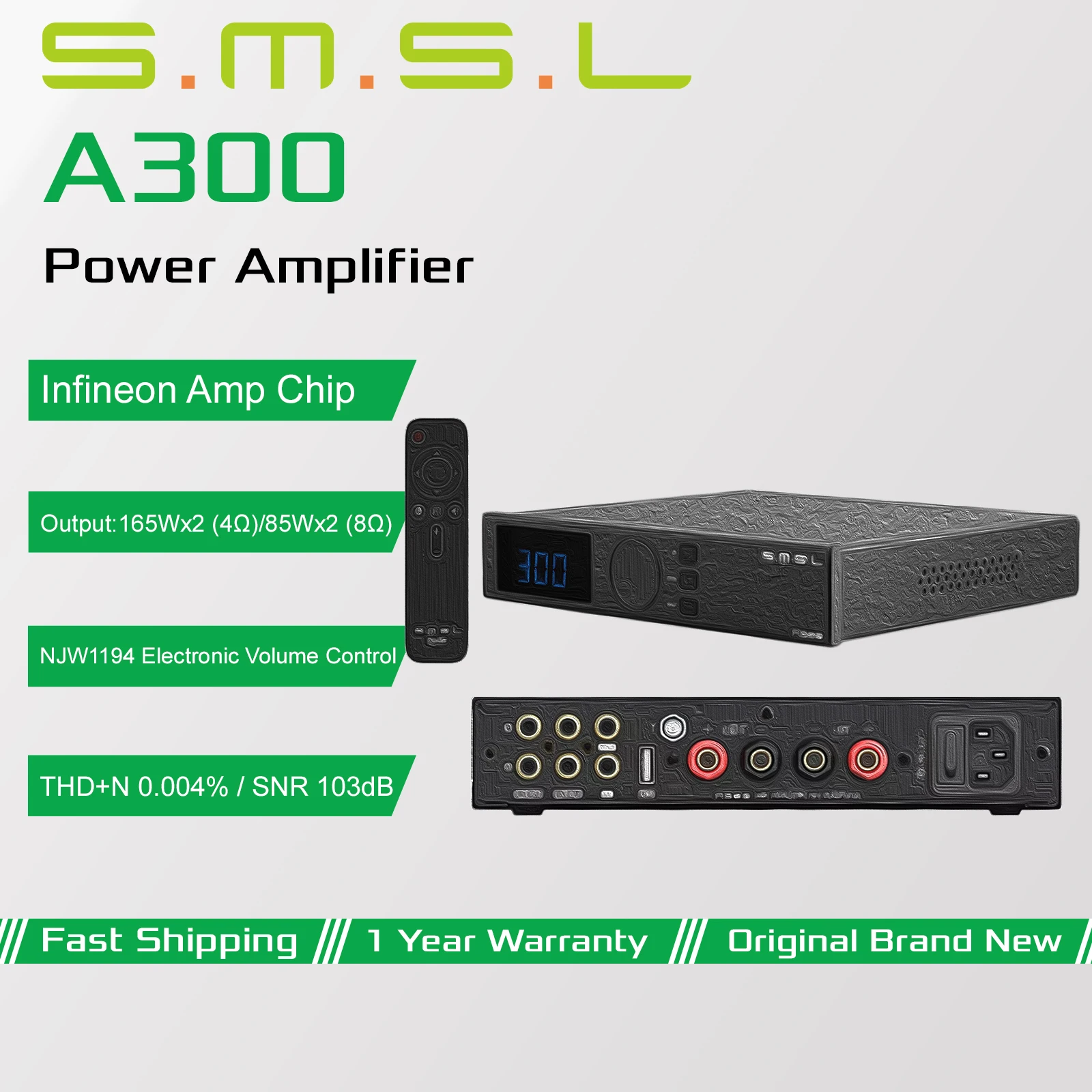
Power Delivery and Architecture: Infineon MA5332MS
At the center of the SMSL A300 is an Infineon Class D amplifier chipset (identified in Zelpio’s technical overview as the MA5332MS), paired with an NJW1194 electronic volume control ladder. The seller’s promotional documentation rates the unit at 85W × 2 into 8Ω and 165W × 2 into 4Ω, with bridged mono operation (BTL) listed up to 330W.
As with most compact Class D power ratings, these figures represent peak ceiling thresholds under specific total harmonic distortion conditions rather than sustained all-channels-driven continuous clean power across the entire audible band. However, real-world listener reports indicate that the amplifier delivers substantial current for its physical footprint. In independent testing by AudioReviews, the A300 demonstrated sufficient reserve to drive low-impedance, current-hungry bookshelf monitors (such as the PSB Synchrony One B) to room-filling volumes without audible strain or early clipping.
Desktop Power Consideration
For standard nearfield listening distances of 0.8 to 1.2 meters, typical desktop monitors require only 5 to 15 watts of continuous power to achieve 85 dB SPL. The A300’s primary advantage on a desk is not raw volume, but head-room for transient peaks when driving lower-sensitivity (84–86 dB/W/m) passive speakers.
Inputs and Conversion: Digital Stage vs. Dedicated DAC
The rear chassis provides two single-ended RCA analog line inputs, a USB Type-A digital audio terminal, and a Bluetooth 5.0 antenna terminal. Understanding how these inputs behave is critical to planning your signal chain:
- USB Input: The A300 includes internal USB audio conversion for direct PC connection without an external sound card. However, editorial reviews from both iiWi reviews and AudioReviews note that the onboard USB decoding provides basic plug-and-play convenience rather than high-tier digital conversion. AudioReviews observed it performed similarly to a clean onboard computer sound card. For critical monitoring, pairing the amplifier with an external line-level DAC via RCA provides a noticeable jump in resolution and depth.
- Bluetooth Streaming: Wireless playback is supported, though it operates over basic Bluetooth codecs (such as AAC/SBC) and lacks advanced low-latency formats. It serves well for casual background listening from a phone or tablet, but is not intended for lossless desktop mastering.
- Dual RCA Inputs: Having two distinct single-ended line inputs allows you to route both an external desktop DAC and an auxiliary analog source (such as a phono preamp or secondary media player) without manual cable swapping.
Subwoofer Integration and the Fixed 100Hz Filter
One of the A300’s strongest differentiators among compact Class D desktop units is its dedicated line-level Subwoofer Out (RCA). Rather than providing a mere mirrored full-range feed, the A300 incorporates internal crossover routing.
As documented by iiWi reviews, engaging the subwoofer routing applies a fixed 100Hz high-pass filter to the main speaker binding posts, cutting the lowest bass octave from your passive desktop monitors and routing lower frequencies out to your powered subwoofer. This offers clear mechanical benefits: your small bookshelf speakers are relieved of long-excursion low-bass duties, reducing midrange intermodulation distortion. However, because the 100Hz crossover point is non-adjustable, it may cause a slight overlap or gap depending on your subwoofer’s plate amplifier slope and your monitors’ natural low-end roll-off.
Bridged Mono (BTL) Mode: What Desktop Buyers Need to Know
Marketing for the A300 often highlights its 330W BTL (Bridge-Tied Load) output, alongside the labeled "BTL-R" RCA terminal on the rear panel. This feature can be confusing if not planned correctly:
| Configuration | Hardware Required | Advertised Power | Application |
|---|---|---|---|
| Standard Stereo | Single A300 unit | 85W/ch (8Ω), 165W/ch (4Ω) | Standard 2.0 or 2.1 nearfield desktop setup. |
| Dual Monoblock (BTL) | Two A300 units | Up to 330W per mono channel | High-current demand or larger room setups (one amp per speaker). |
A single A300 cannot provide 330 watts across both stereo channels simultaneously. Running in bridged mono mode requires purchasing two separate A300 units—one serving the left channel, the second serving the right. For nearly all desktop workstations, a single unit in standard stereo mode provides far more power than nearfield listening requires.
Workspace Ergonomics and Daily Usability
From a desk-setup perspective, the A300 includes several functional touches that streamline cable management:
- Internal Power Supply: Unlike many budget desktop amplifiers that rely on an unwieldy external power transformer "brick," the A300 features an integrated internal supply. It connects directly via a standard IEC C13 power cord, significantly cleaning up under-desk wiring.
- Display and Menu Navigation: A front-panel rotary encoder and digital read-out allow direct control over volume, input toggling, and preset DSP profiles. The system includes 8 equalization curves, including direct bypass (E0) and SMSL’s proprietary "SDB" dynamic loudness curve, alongside basic independent bass and treble adjustments.
- Chassis Weight: Because the aluminum chassis is relatively compact and lightweight, stiff, heavy gauge audiophile speaker cables or rigid interconnects can easily pull the unit backward. Flexible cables with lightweight banana plugs are strongly recommended.
Sound Profile Considerations
Sonic impressions among hands-on reviewers highlight a distinct sonic personality that buyers should match to their speakers. iiWi reviews found the A300 notably clean, fast, and neutral compared to predecessor units like the DA-9 and AO200. Conversely, AudioReviews noted that while dynamics and soundstage width are impressive, the high frequencies lean energetic and forward, which could sound slightly bright or clinical if paired with already bright, analytical metal-dome tweeters.
Listeners with laid-back, warm, or slightly dark bookshelf monitors are likely to find the A300’s incisive transient attack complementary. Those with forward studio monitors may prefer engaging the onboard tone controls or direct EQ adjustments to balance upper treble response.
Buyer’s Checklist: Evaluating the A300 for Your Desk
Pre-Purchase Verification
- Do you already have a DAC? The A300 excels primarily as an analog power stage. If you demand bit-perfect high-resolution digital playback, budget for an external USB DAC.
- Are you running a 2.1 setup? Check that your powered subwoofer accepts a standard line-level mono RCA input, and ensure your monitors will benefit from the fixed 100Hz high-pass filter.
- Will you need headphones? The SMSL A300 does not feature a front-panel headphone jack. If you switch between cans and desktop speakers, you will need a separate headphone amplifier or pre-DAC with switching capabilities.
- Regional shipping & pricing: Confirm seller terms, return policies, and regional destination compatibility on your retailer’s listing prior to final checkout.
Evaluation is based on published specifications and seller listings. No physical or hands-on testing was conducted; unlisted specifications may still be available from the seller.
